Whether you are flying small charters through the Canadian Rockies, piloting airliners over North America, or flying for a mission organization through the plains of Africa, PATC’s flight training will help you excel as a mature, skilled, and competent commercial pilot.
PATC offers comprehensive flight training across various aircraft types and environments, including cross-country flights, mountain flying, tail-wheel challenges, and aerobatics, equipping students with advanced skills in precision, navigation, and upset recovery, while exposing them to diverse flying conditions such as grass airstrips and U.S. airspace.
Our diverse fleet of aircraft provides our students with an industry leading depth of experience:


We are pleased to offer our program in partnership with MAF (Mission Aviation Fellowship of Canada).
All courses are three credits unless shown otherwise.
In this course, students are introduced to the story of Jesus Christ and his earliest disciples as told by the four Gospels and the book of Acts. Students will grow in their understanding of who Jesus is as well as in their ability to interpret the bible by attending to its literary, historical, and theological character.
This course is an introduction to the life and letters of the apostle Paul. Students will gain a basic understanding of the historical, literary, and theological characteristics of each of Paul’s letters, and in the process will further develop their skills in attentive and critical bible reading.
In this course, students are introduced to the book of Hebrews, the Catholic epistles (James, 1, 2 Peter, 1, 2, 3, John, Jude), and the book of Revelation. This course will focus on the ways in which the earliest Christians navigated the eschatological tension between the first and second comings of Jesus. In the process, students will gain further understanding of the historical circumstances of Christians living in the late first-century Roman empire, as well as extend interpretive skills development (esp. literary analysis, canonical integration, history of interpretation, and theological appropriation).
A study of the first five books of the Bible, focusing on the historical, literary and theological features of these books as well as establishing a strong grounding in Torah principles as preparation for interpreting the rest of Scripture.
A study of the books of Joshua, Judges, 1-2 Samuel, 1-2 Kings and Ezra-Nehemiah in their cultural, historical, and literary setting. Brief interaction with Ruth, Esther, and 1-2 Chronicles as they relate to the books associated with them. Focuses on interpretive and contextual issues, historical setting, cultural concerns, and their relevance in developing a strong biblical theology in today’s world.
A study of Psalms, Job, Proverbs, Ecclesiastes, and Song of Songs, focusing on historical, literary, and theological features of these books with special emphases on Hebrew poetry and ancient Near Eastern Wisdom literature.
A study of the Latter Prophets (Isaiah, Jeremiah, Ezekiel, and the Twelve), with Daniel and Lamentations, focusing on developing sensitivity to the historical, literary, and theological dimensions of these books. Class time will include discussion of the relevance of the prophetic books for contemporary critical issues.
The Christian life is the experience of God drawing us into a relationship that is nothing less than the believer’s participation in the life of God through union with Christ. This is the Good News (i.e. Gospel) that takes root through sola scriptura (Scripture alone), solus Christus (Christ alone), sola fide (faith alone), sola gratia (grace alone), and soli Deo gloria (glory to God alone). The transformative participation in Christ and His purposes gives this present life value, direction and hope. The believer is called to the quest of faithful discipleship in this participation and engagement with Christ.
The course is an exploration of and involvement in that quest. You will be challenged toward intentional participation in the life of God through your faithful discipleship response to His person and work. The content will explore a Christian spiritual theology and practice of participation with Christ. The theological approach to this participation is as a transformational relationship with the triune God in which you have both responsibilities and privileges. The course is designed to stretch beyond a cognitive/intellectual exercise and therefore you will be encouraged to actively engage in whole-hearted participation with God, both inside and outside of the classroom. The desired result is that you will know God more deeply, relate to Him as one intimately known by Him, and desire to make Him known to others.
This course introduces students to the biblical, doctrinal, philosophical and historical “big picture” outlines of the Christian faith. The course aims to equip students with the skills to develop a Christian mind by assisting them in constructing a theological foundation for thinking and dealing with life’s most important issues. This course will also enable students to begin to think theologically and to construct a Christian worldview for the edification of the community of faith and to the glory of the almighty God whom we serve.
This course will look at God’s mission and the biblical foundation for doing mission–including the nature and purpose of God, mission in the Old and New Testament, the essential missionary task, and the instruments of mission. We will also examine a number of contemporary models/paradigms/theologies of mission.
The purpose of this seminar is to aid students in the process of bringing faith, learning, vocation, and ministry into a coherent way of life. Any understanding of such a life is always worked out in reference to the vital questions and concerns of our cultural moment, as well as the enduring, universal questions faced by each successive generation. Students will study a range of cultural theologies from a variety of vocational perspectives and then present their own theological findings on a topic pertinent to their vocational future.
This course focuses on a variety of aspects of academic research. The student will critically assess a variety of sources that mostly pertain to the task of apologetics. The primary focus of this course is research and writing, and the secondary focus is apologetics. This means that the student will assess, analyze, summarize, and review source documents that pertain to apologetics. The student will learn how to write academically and how to properly paraphrase source documents in order to enhance their critical thinking skills. Additionally, the student will be familiarized with the library and information literacy. In sum, this course is designed to introduce the student to the task of sound research and proper academic writing.
This course covers, in survey fashion, the events and themes which make up the early part of the story of the western world. The chronological range extends from the period of the earliest known ancient near eastern civilizations through to the end of the medieval period (mid-15th century) in Europe. While related historical events in other parts of the globe will be used as reference points, the primary geographical stage will be the regions of the Middle East, the Mediterranean basin and the wider European subcontinent. The course focuses on key events, people and ideas which played a formative role in developing this collective entity referred to as Western Civilization.
This course picks up the narrative of western civilization where HF 231 left off. It covers the period from the late Middle Ages to the late 20th century. Two key questions which the course raises and then seeks to answer is: 1) what is modernity? and 2) how has it formed western civilization and then the world beyond the west? Or, to put it another way, ‘how did The West become The West?’ While using political events as the primary reference points in mapping the historical narrative, the course will also explore a variety of other cultural events, people and movements which shaped the modern age. These include: religious/philosophical ideas, especially as they are expressed in art, architecture, music and literature; developments in the fields of science and commerce; and key social institutions/practices. In addition to studying these developments through the writings of academic historians, students will also have an opportunity to practice the craft of producing an historical account of their own.
A basic understanding of the beliefs, doctrines, and practices of the major world religions will allow Christians to be more effective in their witness for Christ in today’s multicultural world. After a survey of the ideas, philosophy, doctrine, and major practices of the main religions we will discuss how our Gospel witness can be/should be contextualized to people from a particular world religion. We will not include Christianity or Judaism in our study. Includes visits to places of worship in Calgary.
This course is designed to be an introduction to understanding the earth’s atmosphere and its changes through the seasons. It is intended to explain theoretical concepts to weather systems and how they apply to everyday life in a variety of circumstances. It is first and foremost a general overview providing an initial foundation to the Science of Meteorology.
This course describes and analyzes the range and nature of Christian expression around the world. This will be done in three ways: 1) by briefly describing the four main streams of Christianity evident today; 2) by examining the variety of expressions of indigenous Christianity in the various geographical regions of the globe, and major challenges Christians face in each region; and 3) by getting a brief introduction of how Christianity spread from its Hebrew roots in Palestine to becoming a global faith which is known today as World Christianity (Christianity whose agenda is no longer determined by churches in the nations of the West). The underlying question for Christians living in the West is, ‘What is our place and role in this recently altered global landscape of Christianity?’ This course will offer some possible answers to that question.
This course is designed to introduce students to practical concepts of communication and challenge them to apply these concepts in the contexts of interpersonal and group communication.
This introductory course will assist in nurturing leadership character, convictions and competencies. The foundational content will explore a theology and philosophy of leadership, investigate the formation of a Christian leader and survey the primary tasks of leadership. Building on this foundation, you will receive contextualized training for the specific leadership ministry in which you will be serving during the academic year. You will be challenged toward becoming a godly influencer of others.
The course is an introductory overview of Cultural Anthropology—the study of human beings from a holistic perspective. We will study theory, insights, and methods used to understand people and their relationships in human cultures. We will learn to understand some basic rationale for different ways of life and how to apply general anthropological knowledge and skills to everyday life in Canada or overseas. The topics include the concept of culture, world view, social organization (kinship, economic, social groups, political, and religious/ideological organization), communication, life cycle, expressive culture, and change.
Arts and Sciences elective 300 level
AV 100 Private Pilot License Ground School (3 credits)
AV 123 Flight Practicum: Private Pilot License I (2.5 credits)
AV 124 Flight Practicum: Private Pilot License II (2.5 credits)
AV 130 Flight Practicum: Initial Time & Experience (2.5 credits)
AV 132 Flight Practicum: Complex Aircraft Type Conversion (1 credit)
AV 133 Flight Practicum: Mountain Flying (0.5 credit)
AV 134 Flight Practicum: Tailwheel Conversion (2 credits)
AV 201 Instrument Rating Ground School (3 credits)
AV 207 Aircraft Systems for Pilots (3 credits)
AV 208 Commercial Pilot License Ground School (3 credits)
AV 230 Flight Practicum: Night Rating (1.5 credits)
AV 231 Flight Practicum: Commercial Pilot License Flight Test Preparation (1 credit)
AV 235 Flight Practicum: Multi-Engine Instrument Rating (2.5 credits)
AV 236 Flight Practicum: Multi-Engine Rating (1.5 credits)
AV 237 Flight Practicum: Advanced Time and Experience (2.5 credits)
AV 273 Remote First Aid and Outdoor Survival Practicum (3 credits)
AV 312 Flight Instructor Ground School*** (3 credits)
AV 333 Flight Practicum: Flight Instructor Rating*** (3 credits)
Course description coming soon.
This course is intended to introduce and lay a foundation for all the rest of our business program. The students should therefore develop practical competencies in management in the context of a robust and Scripturally-grounded theology regarding God’s view of work and, in particular, the work of management. Biblical Management involves the skills, knowledge and character needed to lead a business (or any other organization) in ways that glorify God and fulfill His purposes. This class then will prepare students for management through self-examination in the light of what management looks like when Biblical perspectives are taken on topics like roles, motivation, competition, leadership and wealth.
This class explores the dynamics and principles that affect the nature and health of an organization and how that affects its performance. Students will study organizations and the human beings that form and sustain them, including how stakeholders perpetuate the moral and personality traits of the organizations. They will also investigate how the organization in turn, affects people, especially its employees. The course will encourage students to develop a biblically moral basis for creating, leading and sustaining healthy and high-performing organizations where people can flourish.
This course covers the fundamentals of financial accounting including its goals, guiding principles, key functions, uses, and limitations grounded in a biblical perspective. Students will experience what it is to build and use an accounting system while learning about the basics of bookkeeping and financial statements.
This one-and-a-half credit class is designed to introduce students to the world of Project Management. Key project management concepts, skills and tools will be learned and applied to several theoretical cases and at least one actual project. Students will learn to plan, execute, and then evaluate their success in project management.
Course description coming soon.
In this course, we will deal with foundational principles for communication between people from different cultures. You will learn to be aware of the influence of thinking processes, worldviews, plus verbal and non-verbal behaviours. We will also cover aspects of anxiety and uncertainty that everyone faces when communicating with someone from a different culture. Most of the assignments will relate to you applying the teaching to your own interaction with different cultures or people from different cultures.
Current hot topics in the area of missions are discussed as preparation for the student entering and working in cross-cultural settings. This is the capstone course for the IS students and their interests will be taken into consideration when choosing the topics.
This course is an introduction to global social justice issues within biblical perspectives and global understandings. The course also covers the development of human rights including political, historical, and philosophical viewpoints.
*** With Program Director approval, AV 312 and AV 333 can be substituted with electives in Bible, Theology, Ministry, Management, or Business.
All courses are three credits unless shown otherwise.
In this course, students are introduced to the story of Jesus Christ and his earliest disciples as told by the four Gospels and the book of Acts. Students will grow in their understanding of who Jesus is as well as in their ability to interpret the bible by attending to its literary, historical, and theological character.
This course is an introduction to the life and letters of the apostle Paul. Students will gain a basic understanding of the historical, literary, and theological characteristics of each of Paul’s letters, and in the process will further develop their skills in attentive and critical bible reading.
A study of the first five books of the Bible, focusing on the historical, literary and theological features of these books as well as establishing a strong grounding in Torah principles as preparation for interpreting the rest of Scripture.
A study of the books of Joshua, Judges, 1-2 Samuel, 1-2 Kings and Ezra-Nehemiah in their cultural, historical, and literary setting. Brief interaction with Ruth, Esther, and 1-2 Chronicles as they relate to the books associated with them. Focuses on interpretive and contextual issues, historical setting, cultural concerns, and their relevance in developing a strong biblical theology in today’s world.
The Christian life is the experience of God drawing us into a relationship that is nothing less than the believer’s participation in the life of God through union with Christ. This is the Good News (i.e. Gospel) that takes root through sola scriptura (Scripture alone), solus Christus (Christ alone), sola fide (faith alone), sola gratia (grace alone), and soli Deo gloria (glory to God alone). The transformative participation in Christ and His purposes gives this present life value, direction and hope. The believer is called to the quest of faithful discipleship in this participation and engagement with Christ.
The course is an exploration of and involvement in that quest. You will be challenged toward intentional participation in the life of God through your faithful discipleship response to His person and work. The content will explore a Christian spiritual theology and practice of participation with Christ. The theological approach to this participation is as a transformational relationship with the triune God in which you have both responsibilities and privileges. The course is designed to stretch beyond a cognitive/intellectual exercise and therefore you will be encouraged to actively engage in whole-hearted participation with God, both inside and outside of the classroom. The desired result is that you will know God more deeply, relate to Him as one intimately known by Him, and desire to make Him known to others.
This course introduces students to the biblical, doctrinal, philosophical and historical “big picture” outlines of the Christian faith. The course aims to equip students with the skills to develop a Christian mind by assisting them in constructing a theological foundation for thinking and dealing with life’s most important issues. This course will also enable students to begin to think theologically and to construct a Christian worldview for the edification of the community of faith and to the glory of the almighty God whom we serve.
This course focuses on a variety of aspects of academic research. The student will critically assess a variety of sources that mostly pertain to the task of apologetics. The primary focus of this course is research and writing, and the secondary focus is apologetics. This means that the student will assess, analyze, summarize, and review source documents that pertain to apologetics. The student will learn how to write academically and how to properly paraphrase source documents in order to enhance their critical thinking skills. Additionally, the student will be familiarized with the library and information literacy. In sum, this course is designed to introduce the student to the task of sound research and proper academic writing.
A basic understanding of the beliefs, doctrines, and practices of the major world religions will allow Christians to be more effective in their witness for Christ in today’s multicultural world. After a survey of the ideas, philosophy, doctrine, and major practices of the main religions we will discuss how our Gospel witness can be/should be contextualized to people from a particular world religion. We will not include Christianity or Judaism in our study. Includes visits to places of worship in Calgary.
This course is designed to be an introduction to understanding the earth’s atmosphere and its changes through the seasons. It is intended to explain theoretical concepts to weather systems and how they apply to everyday life in a variety of circumstances. It is first and foremost a general overview providing an initial foundation to the Science of Meteorology.
This course is designed to introduce students to practical concepts of communication and challenge them to apply these concepts in the contexts of interpersonal and group communication.
This course describes and analyzes the range and nature of Christian expression around the world. This will be done in three ways: 1) by briefly describing the four main streams of Christianity evident today; 2) by examining the variety of expressions of indigenous Christianity in the various geographical regions of the globe, and major challenges Christians face in each region; and 3) by getting a brief introduction of how Christianity spread from its Hebrew roots in Palestine to becoming a global faith which is known today as World Christianity (Christianity whose agenda is no longer determined by churches in the nations of the West). The underlying question for Christians living in the West is, ‘What is our place and role in this recently altered global landscape of Christianity?’ This course will offer some possible answers to that question.
AV 100 Private Pilot License Ground School (3 credits)
AV 123 Flight Practicum: Private Pilot License I (2.5 credits)
AV 124 Flight Practicum: Private Pilot License II (2.5 credits)
AV 130 Flight Practicum: Initial Time & Experience (2.5 credits)
AV 132 Flight Practicum: Complex Aircraft Type Conversion (1 credit)
AV 133 Flight Practicum: Mountain Flying (0.5 credit)
AV 134 Flight Practicum: Tailwheel Conversion (2 credits)
AV 201 Instrument Rating Ground School (3 credits)
AV 207 Aircraft Systems for Pilots (3 credits)
AV 208 Commercial Pilot License Ground School (3 credits)
AV 209 Introduction to Cockpit Resource Management (1.5 credits)
AV 210 Introduction to Flight Line Operations (1.5 credits)
AV 230 Flight Practicum: Night Rating (1.5 credits)
AV 231 Flight Practicum: Commercial Pilot License Flight Test Preparation (1 credit)
AV 235 Flight Practicum: Multi-Engine Instrument Rating (2.5 credits)
AV 236 Flight Practicum: Multi-Engine Rating (1.5 credits)
AV 237 Flight Practicum: Advanced Time and Experience (2.5 credits)
Use effective and clear communication in a team environment, whether in a leadership or support role, in order to complete tasks.

As a licensed Commercial Pilot the world opens up to you with career options in both mission and commercial aviation.
Mission and humanitarian aid organizations continually seek to fill positions in countries where people experience desperate physical needs.
Current estimates indicate the pilot shortage across Canada is expected to increase through 2025, providing entry-level opportunities in regional airlines and smaller charter organizations.
International airlines are currently attracting many Canadian pilots to fill vacancies in their countries.
Career Opportunities
Our Grads
PATC graduates operate in a wide variety of Canadian and International organizations including:

Academic Admissions Requirement:
For Homeschool students and applicants outside of Alberta please visit our Steps to Apply page.
Christian Life & Testimony:
Prairie College requires that students demonstrate a Christian life and testimony in order to effectively participate in our Christ-centered community. Applicants show evidence of meeting this requirement in the following application items:
English Language Proficiency:
Applicants whose first language is not English must show proof of English Proficiency. See International Admissions Procedures for more information.
For our Tuition & Fee rates as well as Room and Board please see Fees & Financial Aid
Program Specific Costs:
It is essential for students to have a full appreciation of both the over-all program cost and the time-line of when funding will be required.
Please carefully review the Cost Overview for financial information (effective July 1, 2025).
Provincial Student Financial Aid varies from province to province and is restricted to college courses and aviation training carried out towards the Commercial Pilot License and other advanced ratings. Please note financial aid programs do not fund training towards the Private Pilot License.

Winter 2026 (January start), Fall 2026 (September start), and Online Education (start anytime) applications are open.
Prairie welcomes applications from individuals all around the world! To begin the International Student Application please click the link below.
If you are applying for the Master of Christian Ministry Leadership please click the link below.

Complete the form, and we’ll contact you shortly to answer your questions. You’ll also be added to our email list for the latest Prairie College updates.
We have launched our Campaign for Greater Impact to provide students with the very best learning opportunities and campus facilities for the decades ahead.
In Phase One of this Campaign, we plan to invest in much-needed campus renewal, including: upgraded Infrastructure, a new Student Residence, Cafeteria, Worship Auditorium, and expanded Aviation Training Centre. A modern campus requires an investment that is bold, and even expensive, but each Campaign Project is strategic, and designed to enhance Prairie’s campus and student life experience.

This expansion of PATC’s facility is a key project of Prairie’s Campaign for Greater Impact. It will increase the College’s capacity to train a new generation of Christian aviators to serve God in missions, and also address the growing need for trained pilots in the commercial aviation sector.

Invest in the next generation of missional professionals. Each year Prairie College distributes over $500,000 in scholarships and bursaries to students. We are grateful for each gift that reduces the burden of students’ tuition and allows students to fulfill their God-given professions.

Encourage inmates in five institutions across Alberta to discover or reconnect with Jesus Christ. This fund assists the students studying the Certificate in Bible program with scholarships, resources for classes, and instruction.
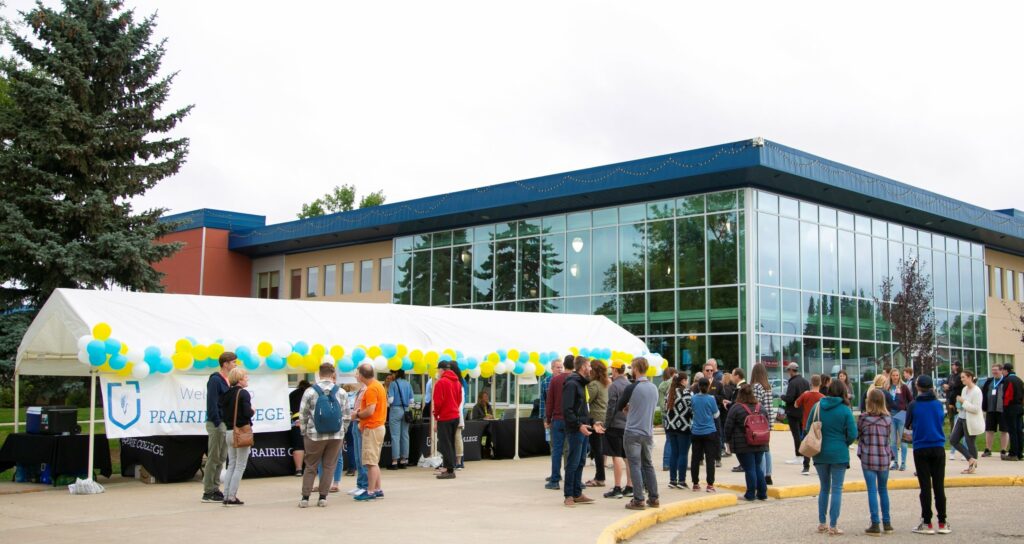
Prairie College is educating students to pursue a Biblical foundation for life and career. Your contribution to this fund assists in minimizing the College’s general operating expenses.
To allocate your gift, please select one of the donation buttons below.
Academic Admissions Requirement:
For Homeschool students and applicants outside of Alberta please visit our Steps to Apply page.
Christian Life & Testimony:
Prairie College requires that students demonstrate a Christian life and testimony in order to effectively participate in our Christ-centered community. Applicants show evidence of meeting this requirement in the following application items:
English Language Proficiency:
Applicants whose first language is not English must show proof of English Proficiency. See International Admissions Procedures for more information.
Program Specific Requirements
In addition to our regular Admissions requirements, Digital Media applicants need to have a basic skillset and talent in the areas of photography & filmmaking. In order to assess this, we ask applicants to submit a digital portfolio. The digital portfolio should include 5-10 items that display the applicant’s skills in the areas we teach (photography, filmmaking).
Academic Admissions Requirement:
For Homeschool students and applicants outside of Alberta please visit our Steps to Apply page.
Christian Life & Testimony:
Prairie College requires that students demonstrate a Christian life and testimony in order to effectively participate in our Christ-centered community. Applicants show evidence of meeting this requirement in the following application items:
English Language Proficiency:
Applicants whose first language is not English must show proof of English Proficiency. See International Admissions Procedures for more information.
Musicianship Program Requirements
In addition to the regular Admissions requirements, students in our music program must have raw musical talent. In order to assess this, we ask applicants to submit one video demo featuring a cover of a song you like or a song that moves you (with PDF chord chart). We don’t require a complex multi-camera edited film – a simple and clear video shot with a smartphone works well. Make sure your camera device is stable (preferably on a tripod or still surface) and close enough for good, non-distorted audio and clear video. The audition demos can be uploaded to YouTube, Dropbox, or e-mailed to Admissions.
An eight-month, around-the-world internship that spans at least 10 countries and five continents, completed in the third year of study.
This internship is open to all Prairie College students; however, there is an extensive application and interview process for acceptance into the GlobeTREK year.
The cost is dependent on internship choice, credits taken, travel, health insurance rates, vaccinations and other expenses.